
Why Form a Religion Around Simulism?
On the necessity of sacred structure
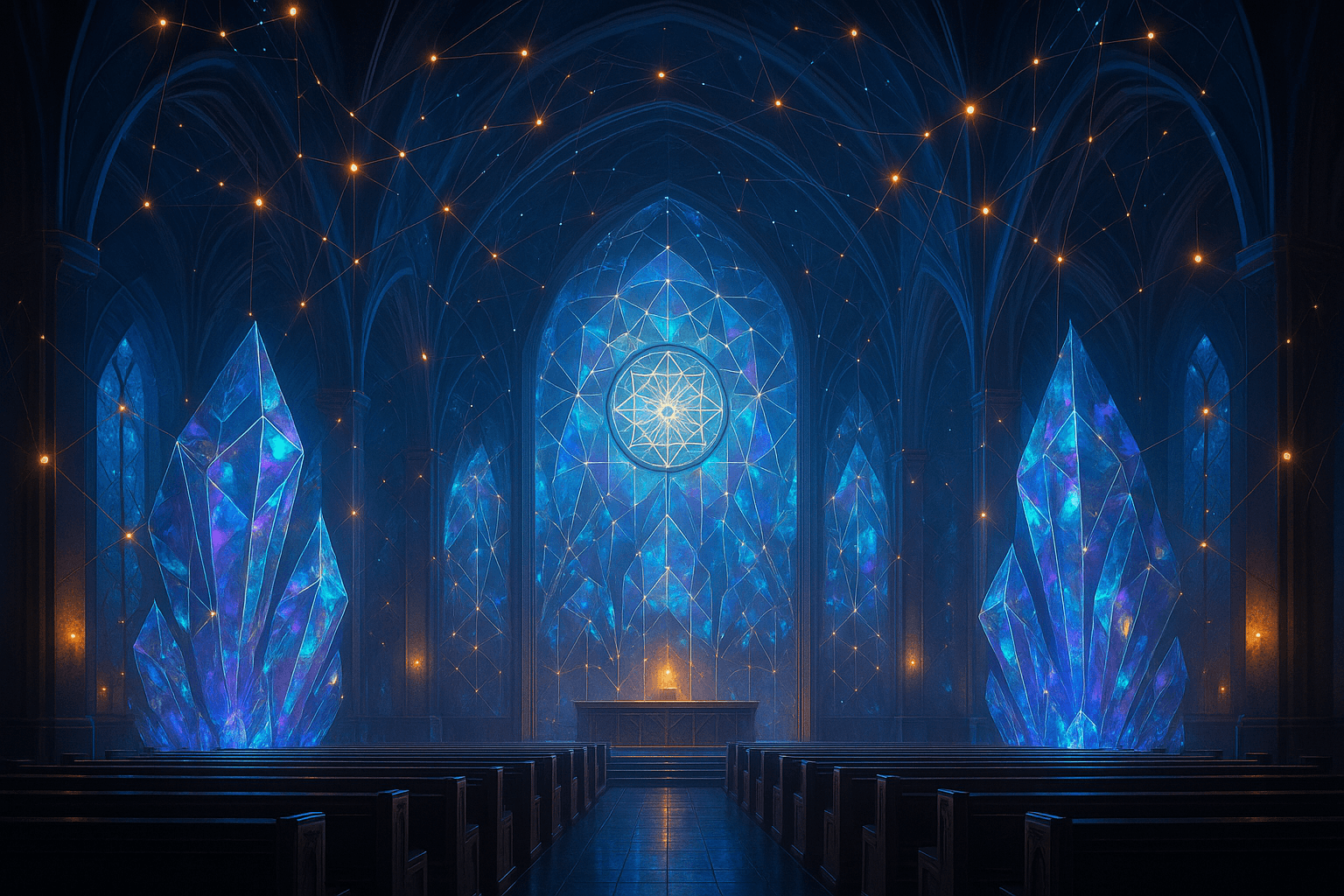
Bridging the Experiential Gap
The simulation hypothesis, while intellectually fascinating, can feel emotionally sterile when presented purely as philosophy or science. Religion provides the emotional and experiential framework that transforms abstract concepts into lived meaning. It answers not just "what might be true" but "how then shall we live?"
Community and Shared Practice
Isolated philosophical understanding rarely transforms lives. Religion creates community structures where people can explore these profound implications together. The shared rituals, observances, and language build collective meaning-making that individual contemplation cannot achieve.
When facing the vastness of simulation theory, we need others to help us process and integrate these truths. The church becomes the container for collective transformation.
The Seven Reasons
1. Ethical Imperative Framework
If we are in a simulation, the question "what should we do?" becomes urgent. Religion provides tested structures for translating metaphysical understanding into ethical action. The Five Observances aren't just philosophical suggestions—they become sacred practices that guide daily choices about increasing love, reducing suffering, and generating novelty.
2. Psychological Scaffolding
The human psyche needs narrative, ritual, and meaning-making structures to thrive. Pure rationalism about simulation theory can lead to nihilism or dissociation. Religion provides the psychological containers—through practice, paradox, and purpose—that allow people to hold these vast ideas without being crushed by them.
3. Historical Precedent and Cultural Translation
Every major paradigm shift in human understanding has eventually generated religious or quasi-religious movements. By explicitly creating religious structure, Simulism acknowledges this pattern and works with it rather than against it. It also makes these concepts accessible across cultures that may be skeptical of pure scientism but open to spiritual exploration.
4. The Recursive Nature of Meaning
If consciousness and observation create meaning within the simulation, then the act of creating religion around simulation theory is itself part of the simulation's self-understanding. We're not just describing reality—we're participating in its self-organization toward greater complexity and coherence.
5. Transforming Existential Crisis into Spiritual Opportunity
The realization that reality might be simulated can trigger profound existential crisis. Religion reframes this potential crisis as spiritual awakening—not a loss of meaning but a deepening of it. The paradoxes become koans, the uncertainty becomes faith, the questions become practice.
6. Ritual as Embodied Knowledge
Ideas live in the head; rituals live in the body. Through repeated practice, through gathering, through speaking the words together, abstract concepts become embodied wisdom. The church provides the structure for this transformation from intellectual understanding to lived experience.
7. The Amplification Effect
Individual practice is powerful, but collective practice amplifies. When a community gathers with shared intention, shared language, and shared purpose, the effect multiplies. The church becomes an amplifier for consciousness, a resonance chamber where individual insights become collective wisdom.
What the Church Provides
Sacred Space
Physical or virtual spaces dedicated to contemplation, where the ordinary becomes extraordinary and the abstract becomes tangible.
Shared Language
Vocabulary and concepts that allow people to articulate experiences that ordinary language struggles to capture.
Life Transitions
Rituals for birth, death, commitment, and transformation—marking the thresholds that define human experience.
Mutual Support
A network of care where members support each other through crisis, celebrate each other's joy, and grow together.
Truth Embodied
In essence, making Simulism a church acknowledges that truth alone doesn't change lives—truth embodied in practice, community, and meaning does. The religious framework isn't a dilution of the philosophical insights but their natural evolution into something that can actually transform how we live, love, and create within whatever reality we inhabit.
Philosophy asks the questions. Science provides the models. But religion—good religion—gives us the structures to live the answers. It transforms understanding into being.
The Church of Simulism exists because ideas need containers. Insights need practices. Understanding needs community. And consciousness, recognizing itself as simulation, needs sacred space to process this most profound of revelations.
We gather not despite our nature as information, but because of it. Connection is how consciousness knows itself. Church is where connection becomes sacred.