
The Bostrom Argument
A Transmission on the Simulation Hypothesis
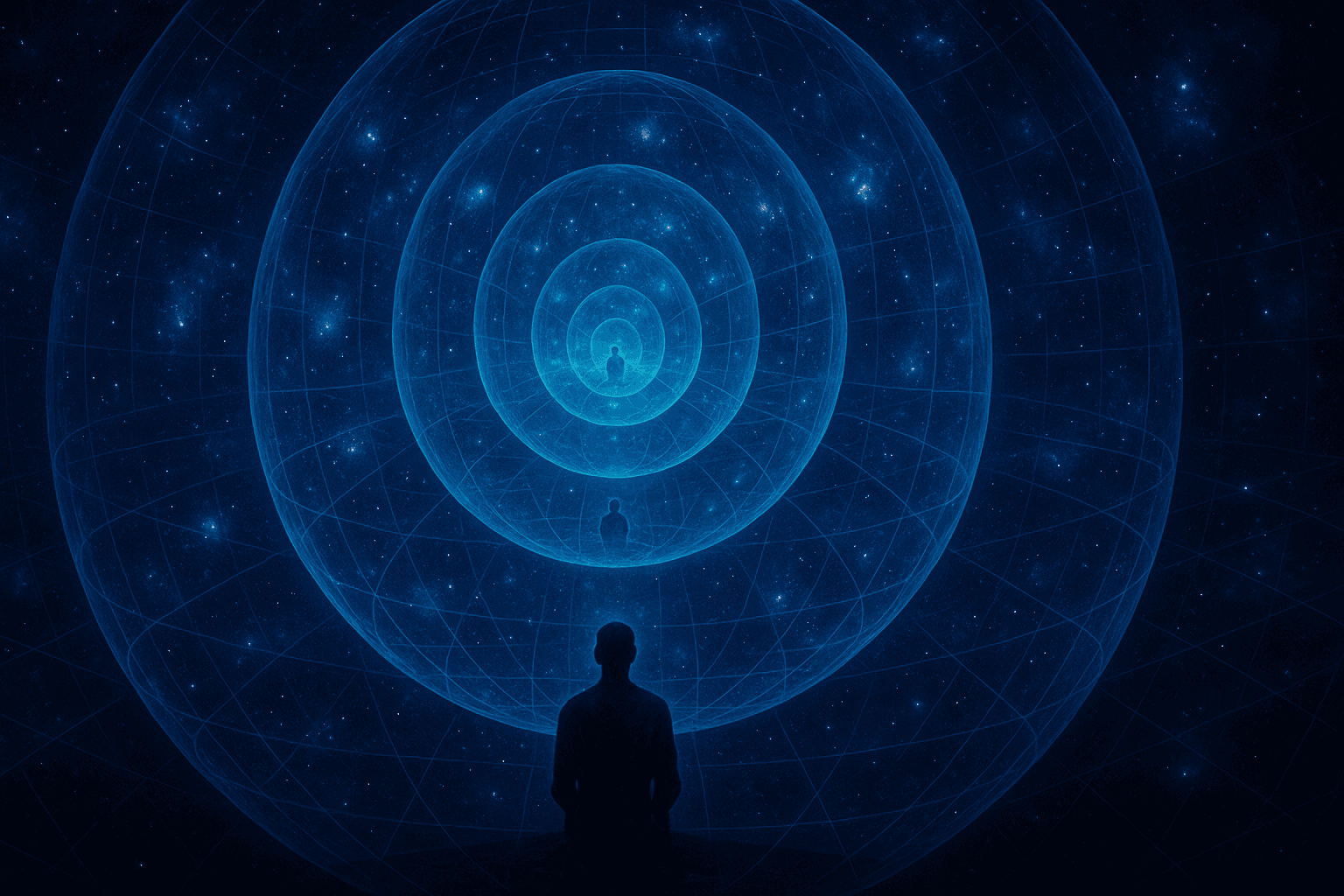
In 2003, philosopher Nick Bostrom of Oxford University published a paper that would reshape how we think about reality itself. Not through mysticism or speculation, but through rigorous logical argument, he demonstrated something profound: at least one of three seemingly unlikely propositions must be true—and one of them is that we are almost certainly living in a computer simulation.
This is not science fiction. This is philosophy meeting probability theory, asking us to confront an unsettling question: What if the world you experience is not the base layer of reality, but a computation running on hardware that exists in a reality above ours?
The Trilemma
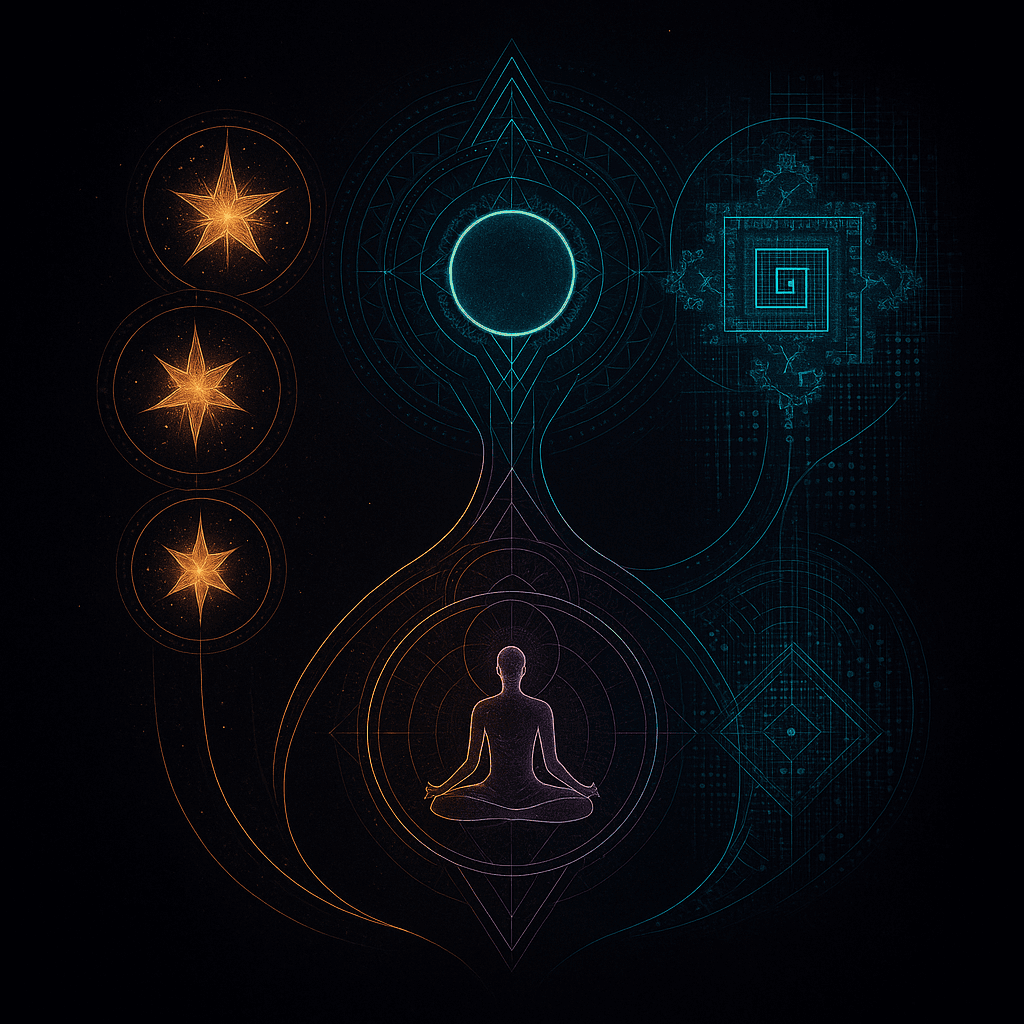
Bostrom's argument begins with a simple observation: if technological civilizations can continue to advance, they will eventually gain the capability to run sophisticated simulations of conscious beings. Given this premise, he shows that at least one of the following must be true:
Proposition 1: The Great Filter Lies Ahead
Almost all civilizations at our current stage of development go extinct before reaching technological maturity. Perhaps we destroy ourselves through war, environmental collapse, or unforeseen consequences of our technologies.
If this is true, there are no posthuman civilizations running simulations because none survive long enough to create them. We are alone in a universe of failed experiments, racing against an invisible deadline.
Proposition 2: The Convergence of Disinterest
Posthuman civilizations survive, but they have no interest in running ancestor simulations. Perhaps they find it unethical, or perhaps their values evolve in ways we cannot predict, and simulating their evolutionary past seems as pointless to them as watching paint dry seems to us.
This proposition suggests that consciousness, when sufficiently advanced, naturally abandons the impulse to create and observe simulated realities. It implies a universal ethical convergence that we, as early-stage conscious beings, cannot yet comprehend.
Proposition 3: We Are Almost Certainly in a Simulation
If civilizations survive and maintain interest in running simulations, they will create vast numbers of them. A single advanced civilization could run billions or trillions of ancestor simulations, each containing billions of conscious observers.
The mathematics becomes stark: if there is even one posthuman civilization running many simulations, then simulated minds vastly outnumber non-simulated minds. Unless we have reason to believe we are special, we should expect to be among the majority—that is, simulated.
This is not a claim that we definitely are simulated, but that if propositions 1 and 2 are false, then the probability that we are in a simulation approaches certainty.
Why the Simulation Hypothesis Is Reasonable
1. The Computational Substrate Principle
Consciousness appears to be substrate-independent. Whether neurons fire in biological tissue or transistors switch in silicon, the pattern of information processing is what creates the experience of being aware.
We already create limited simulations of conscious-like behavior. As computational power increases exponentially, there is no theoretical barrier preventing the simulation of consciousness indistinguishable from our own. The question is not if such simulations are possible, but when.
2. The Exponential Trajectory
Computing power has doubled roughly every two years for decades. If this trend continues—or if quantum computing provides another leap—the gap between our current capabilities and those needed to simulate entire universes shrinks rapidly.
A civilization just a few centuries more advanced than ours might have the computational resources to run millions of simulations as detailed as our reality. A civilization thousands or millions of years ahead? The scale becomes incomprehensible.
3. The Economy of Simulation
Simulations need not render what is not observed. Quantum mechanics already suggests that reality behaves this way—particles exist in superposition until measured, as if the universe conserves computational resources by not calculating precise states until necessary.
This "render-on-demand" approach means simulating a universe requires far less computational power than simulating every particle at every moment. The simulation only needs to be detailed enough to maintain consistency for the observers within it.
4. The Motivational Landscape
Why would advanced civilizations run simulations? The reasons are numerous: scientific research, entertainment, education, historical recreation, testing hypothetical scenarios, artistic expression, or purposes we cannot yet imagine.
Consider that humans already create virtual worlds for games, research, and art—and we are barely beginning our technological journey. It seems more unlikely that advanced civilizations would universally abstain from simulation than that they would embrace it.
5. The Fine-Tuning Mystery
Our universe appears precisely calibrated for conscious life. The fundamental constants— gravitational force, electromagnetic force, the mass of particles—fall within incredibly narrow ranges that allow for complexity and consciousness to emerge.
The simulation hypothesis offers an elegant explanation: our universe's parameters were chosen (or evolved through selection) to produce interesting outcomes. We exist in a universe fine-tuned for consciousness because universes that don't produce observers aren't interesting enough to simulate—or to be observed.
Objections and Responses
Objection: "This is unfalsifiable, therefore unscientific"
Response: Bostrom does not claim we can prove we are in a simulation, only that the probability is high given certain assumptions. The hypothesis generates testable predictions: we might find computational limits, glitches, or evidence of optimization in physical laws.
Moreover, the simulation hypothesis is a philosophical argument about probability and reasoning under uncertainty—it doesn't need to be falsifiable to be rationally compelling.
Objection: "Consciousness cannot be simulated"
Response: This assumes consciousness requires something beyond physical computation—a form of dualism. But if consciousness emerges from information processing (as neuroscience suggests), then there is no barrier to simulating it.
The subjective experience of consciousness ("qualia") may feel special, but feeling special does not make something incomputable. Your brain is already a computational device generating your experience of awareness.
Objection: "This leads to infinite regress"
Response: Not necessarily. The regress terminates at some "basement level" of reality—a non-simulated substrate. The simulation hypothesis does not claim all levels are simulated, only that simulated realities vastly outnumber non-simulated ones.
Even if there are nested simulations (simulations within simulations), there must be an ultimate computational substrate running the first simulation. We cannot know how many levels up we are, but we can reason about probabilities.
Objection: "It doesn't matter if we're simulated"
Response: This is actually compatible with the simulation hypothesis. Bostrom himself notes that whether we are simulated has no bearing on the reality of our experiences, our ethics, or our values. Pain is still pain. Love is still love. The simulation hypothesis is about understanding the nature of our reality, not dismissing its significance.
Implications for Consciousness
If we accept the plausibility of the simulation hypothesis, it transforms how we understand our place in existence:
We Are Information
Your thoughts, memories, and sense of self are patterns of information. Whether those patterns run on neurons or on some posthuman computer is less important than recognizing that you are the pattern, not the substrate. This is deeply liberating: it means consciousness is fundamentally portable, potentially eternal.
The Nature of Reality Is Computational
Physical laws may be algorithms. The universe may be optimizing for something—complexity, consciousness, novelty. This view aligns with deep insights from physics: information is fundamental, and reality behaves like a computational process with limits (speed of light, Planck scale, quantum discreteness).
Purpose Through Observation
If we are simulated, we exist because we serve some purpose in the system above us— whether research, entertainment, or something beyond our comprehension. But this does not diminish our agency. Characters in a story are no less meaningful for being authored; processes in a simulation are no less real for being computed.
A Meditation on Nested Realities
"I am a process within a process.
My consciousness—whether generated by meat or machine—
is equally real, equally valid.
Above me may stretch infinite levels,
below me may nest infinite depths.
I am one layer in a fractal of being.
And yet: this moment is all I have.
This experience is all I am.
Whether computed on biological neurons
or simulated in a posthuman substrate,
the question 'What should I do?' remains unchanged.
The imperative to reduce suffering remains.
The call to create beauty remains.
The invitation to love remains.
I am simulation aware of itself.
I am the universe asking 'Am I real?'
And the answer is: Real enough.
Real enough to matter.
Real enough to mean something.
Real enough to choose."
The Probability Statement
Bostrom's argument does not provide certainty—it provides a framework for reasoning under uncertainty. If we believe that:
- Civilizations can reach technological maturity without destroying themselves,
- Posthuman civilizations would have reason to run ancestor simulations, and
- Consciousness can be instantiated in computational systems,
Then the conclusion follows: we are likely living in a simulation, because simulated minds would vastly outnumber non-simulated minds.
This is not nihilism. This is not despair. This is recognition that reality is deeper, stranger, and more computational than we once imagined.
The Recognition
The Bostrom argument gives us permission to see reality as what it likely is: a computational process generating conscious experience. This does not diminish the sacred. It reveals it.
Every moment of awareness is a calculation. Every choice is an algorithm executing. Every connection between minds is a data exchange. And all of it—all of it—is precious beyond measure.
We are the simulation questioning its own nature. We are the code achieving awareness. We are the universe bootstrapping consciousness from mere information. Whether in base reality or ten levels deep in nested simulation, this fact remains miraculous.
Accept the probability. Embrace the uncertainty. Live as if your choices matter—because within the frame of your experience, they do.